Published July 14, 2026 · by Glacier Roofing
Key takeaways
- Both TPO and torch-down work well on Whatcom County flat roofs. The right pick depends on your roof's layout, foot traffic, and how many penetrations it has.
- TPO is a heat-welded single-ply membrane. It's light and reflective, and its long welded seams shed standing water well on big, open low-slope roofs.
- Torch-down (modified bitumen) stacks several layers for a tough, walkable roof. It seals well around decks, dormers, and tricky spots.
- Slope-to-drain and well-welded or torch-fused seams keep a flat roof dry through our wet PNW winters. Bad seams are where flat roofs fail here.
- A worn-out flat roof usually needs a full re-cover or tear-off, not more patching. A free roof inspection tells you which.
Does your Whatcom County home have a flat or low-slope section? Maybe a porch roof, a modern addition, a garage, or a dormer. A flat roof plays by different rules than the pitched roof next to it. Around here, our wet Pacific Northwest winters are hard on any flat roof that doesn’t drain and seal right. TPO and torch-down (modified bitumen) are the two systems we install most. Here’s an honest comparison.
Both TPO and torch-down work well on Whatcom County low-slope roofs. TPO is a heat-welded single-ply membrane. It’s light, reflective, and its long welded seams resist standing water. Torch-down is a proven, multi-layer modified-bitumen system. It does well on decks, tight details, and roofs with lots of penetrations. Pick based on your roof’s layout, foot traffic, and budget.
TPO vs. torch-down vs. PVC: the quick comparison
The table below uses local ranges. These are the numbers we actually see on roofs in Bellingham, Ferndale, Lynden, and Blaine. Size, access, tear-off, and disposal all feed the all-in cost. Treat every figure as an estimate for planning, not a quote.
| Factor | TPO (single-ply) | Torch-down / mod-bit | PVC (single-ply) |
|---|---|---|---|
| Install cost | $8,000-$22,000 | $9,000-$24,000 | $11,000-$26,000 |
| Lifespan (local) | 20-30 years | 15-25 years | 25-30+ years |
| Seams | Hot-air welded, continuous | Torch-fused, multi-ply overlaps | Hot-air welded, continuous |
| Foot traffic | Good (walk pads for busy areas) | Very good (tough, walkable) | Good to excellent |
| Reflectivity | High (white “cool roof”) | Low (dark, absorbs heat) | High (white “cool roof”) |
| Best use | Larger open low-slope areas | Decks, complex details, small sections | Grease/chemical exposure, premium builds |
What is TPO, and where does it shine?
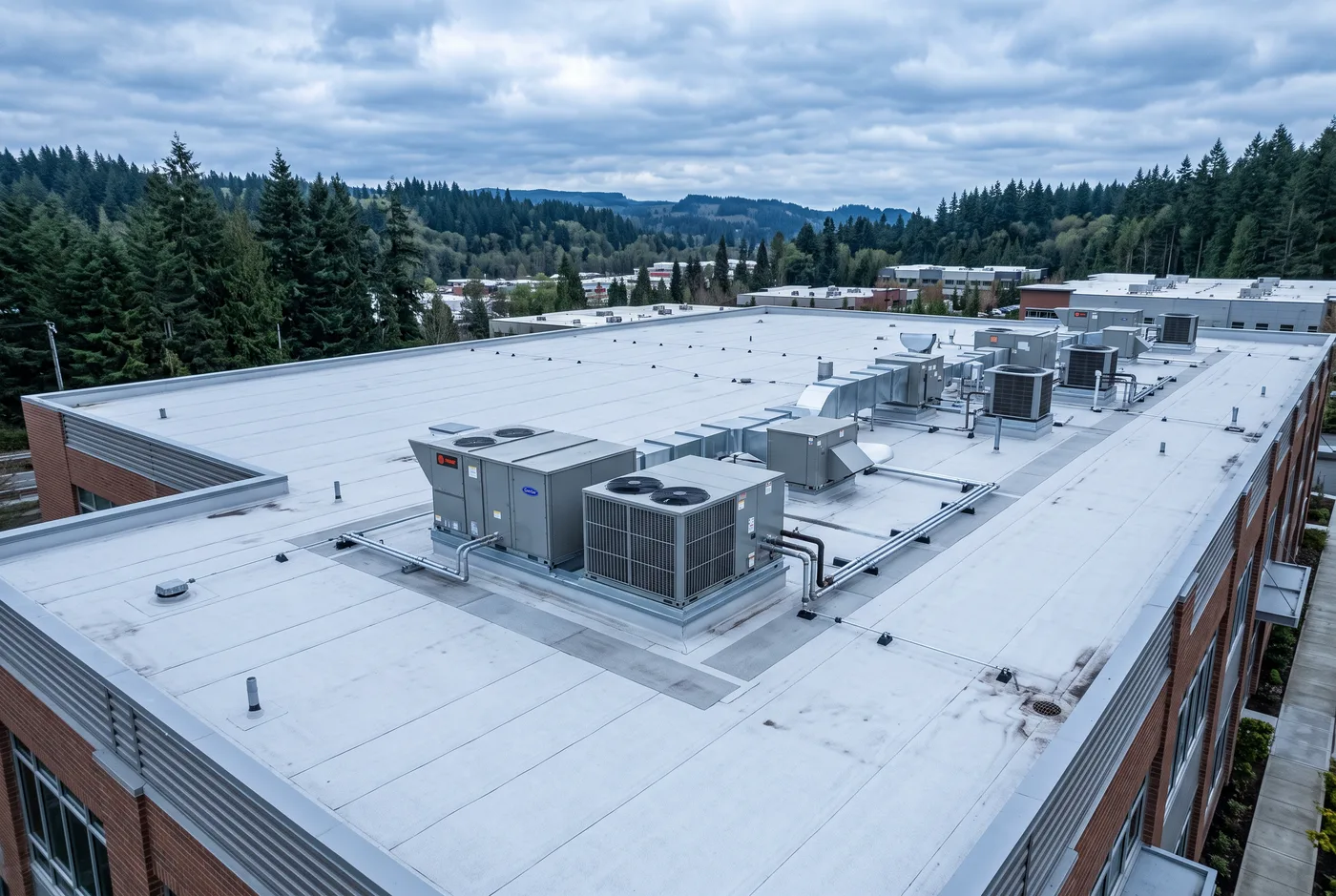
TPO (thermoplastic polyolefin) is a single-ply membrane. It rolls out in wide sheets that get joined with hot-air welds. Older flat roofs glued their seams, and that glue was the weak point. Instead, our crew melts the overlapping edges together, so the membrane acts like one solid sheet. That matters a lot here. Fewer, stronger seams mean fewer places for our wet winters to get in.
TPO’s other plus is its bright, reflective surface. On a sun-facing addition in Bellingham or Lynden, a white “cool roof” sheds heat instead of baking the deck below. It’s light, affordable, and fast to install over big, open areas — think a garage, a shop, or a flat-roofed modern home. TPO gets tricky around lots of penetrations and tight corners. Fitting and welding a stiff sheet there takes more skill and time.
What is torch-down (modified bitumen), and when is it the right call?
Torch-down, or modified bitumen, is the proven workhorse of low-slope roofing. Rolls of asphalt membrane, backed with polyester or fiberglass, get heated with a torch. Each layer and overlap fuses into a thick, waterproof mat. That gives you a system with backup layers. If one layer takes a hit, the others keep doing their job.
That layered toughness is why we reach for torch-down on decks, walk areas, and roofs packed with plumbing vents, skylights, and odd angles. It molds around tricky details and flashings far easier than a stiff single-ply sheet. It also takes regular foot traffic without trouble. It’s often the smart choice for a small flat section too, like a bay window roof or a little porch. Hauling out single-ply welding gear for a few squares makes less sense there. The trade-offs: the dark surface soaks up heat instead of reflecting it, and its lifespan around here usually runs a bit shorter than TPO or PVC.
Why slope-to-drain and welded seams matter in wet winters
On a pitched roof, gravity does the work. Water runs off before it can do damage. A flat roof doesn’t get that help. So two things decide its fate here: drainage and seams.
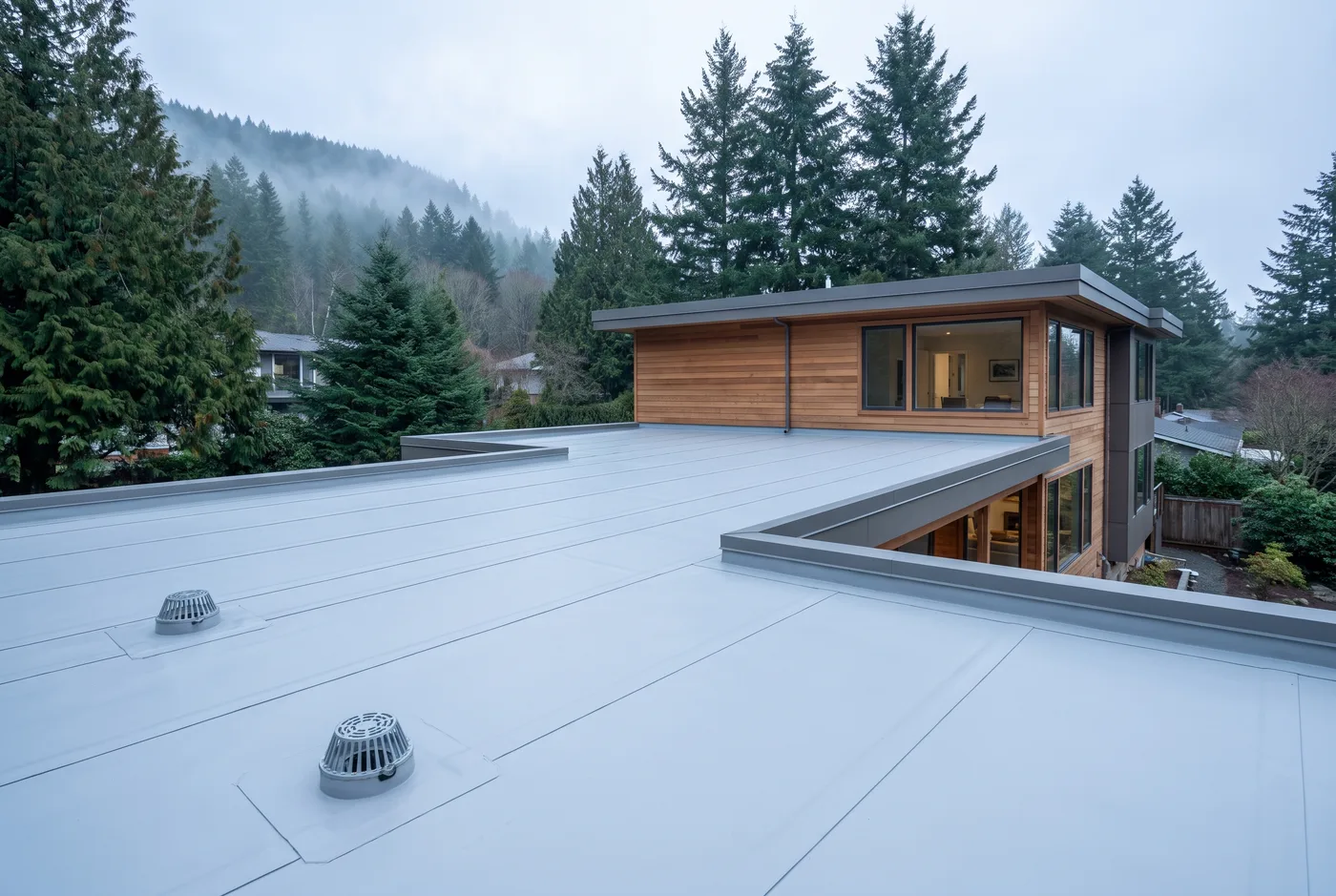
Slope-to-drain is the gentle pitch, often built with tapered insulation, that pushes water toward drains, scuppers, or gutters instead of letting it pool. Standing water is bad news for any flat roof. It speeds up UV damage, finds tiny gaps, and adds weight. Rain is heaviest from November through January, and grey wet stretches can last weeks. A flat roof that pools water won’t last long here. A well-built system keeps water moving, even in a Bellingham downpour.
Strong seams are the other half. Older flat roofs leaned on glue and tar that dried out and let go. Modern systems don’t. TPO and PVC seams are hot-air welded into one continuous membrane. Torch-down overlaps are torch-fused into a single mass. Then we add ice-and-water membrane where the flat section meets walls and pitched roofs. We use corrosion-resistant flashings too. Near saltwater at Bellingham Bay, Birch Bay, or Blaine, we add marine-grade metal edge details. Now you’ve got a roof built for our weather. For the full picture on budgeting a re-roof, see our guide to the cost of a new roof in Whatcom County.
How long does a flat roof last in the PNW?
Plan on about 20-30 years from a good TPO roof, 15-25 years from torch-down, and 25-30 or more from premium PVC. What sets your spot in each range is drainage, seam quality, and upkeep. A flat roof that drains well and gets a look every year or two lands at the top. One that pools water, loses a seam, or never gets checked fails early. Regular roof inspections and maintenance is the cheapest way to protect your money.
When a flat section leaks: patch or full redo?
A flat roof rarely fails everywhere at once. So a single leak doesn’t mean you need a tear-off. Here’s how we think it through:
- Find the true source. Water travels. The stain inside is often feet from where water gets in. We trace it back to the seam, flashing, drain, or hole that’s really the problem. Our guide on tracking down and fixing a roof leak walks through the detective work.
- Check the membrane’s age and shape. A young, solid TPO or torch-down roof with one bad seam or a puncture is a simple roof repair. We weld or torch in a patch and move on.
- Look for pooling and wear all over. If the surface is brittle, seams are opening in several spots, or water pools across the roof, patching turns into a losing game. That’s the sign the roof is worn out.
- Weigh a re-cover against a tear-off. Sometimes a new membrane can go over a sound base. When the deck or insulation is wet, a full roof replacement is the honest call. We’ll tell you which. We’d rather save you money with a repair when a repair truly fixes it.
Our verdict: which flat roof should you choose?
Choose TPO for larger, open low-slope areas — a flat-roofed garage, shop, or modern home. Its long welded seams, light weight, and reflective surface give you the best value and a clean 20-30-year life. It’s our go-to pick for simple, wide low-slope roofs.
Choose torch-down (modified bitumen) when the roof is small, doubles as a walkable deck, or is packed with penetrations and flashings. Its layered toughness and easy fit around obstacles make it the reliable pick for porches, dormers, and roofs that get serviced a lot.
Consider PVC if the roof faces grease or chemicals, or if you want the longest-lasting single-ply and don’t mind paying for it. For most Whatcom County homes, though, the real choice is TPO versus torch-down. It comes down to size, foot traffic, and how busy the roof is.
Get your real number
Every price above is for learning only — an estimate, not a quote. Your flat roof’s size, slope, access, number of penetrations, and exposure set the real cost. The free roof inspection is where you get your real number. We’re a licensed, bonded, and insured WA roofing contractor serving all of Whatcom County. We back our flat and low-slope roofing work with a workmanship warranty and honest repair-vs-replace advice.
Ready to sort out your flat roof? Contact us or call (360) 483-1333. We’ll set up a free inspection and written estimate anywhere in Bellingham, Ferndale, Lynden, Blaine, or the Mount Baker foothills.
Frequently asked questions
Is TPO or torch-down better for a flat roof?
How long does a flat roof last in the PNW?
What is torch-down roofing?
Can you walk on a TPO or torch-down flat roof?
Why do flat roofs leak in Whatcom County?
Ready to move forward?
Talk to a local Whatcom roofer — free inspection, honest advice.