
Published July 12, 2026 · by Glacier Roofing
Key takeaways
- Stop the water first with an emergency tarp. Take photos before you clean up or repair.
- Wind and storm damage is usually covered. Wear, age, and skipped maintenance usually are not.
- File fast. Meet the adjuster with a licensed contractor's written report. Fix the roof last.
- A local Whatcom County crew can tarp your roof the same day — often within hours.
- Outflow winds and foothill snow load hit hard every winter, so photograph the edges, ridges, and gutters closely.
A winter storm rolls in off the water. The northeast outflow winds gust hard down the Nooksack and Fraser valleys, and up in the foothills the snow piles on. By morning you have shingles in the yard and a stain spreading across the ceiling. What you do in the next few hours shapes your home and your insurance claim. This guide walks Whatcom County homeowners through storm damage roof repair and the wind damage insurance claim, step by step.
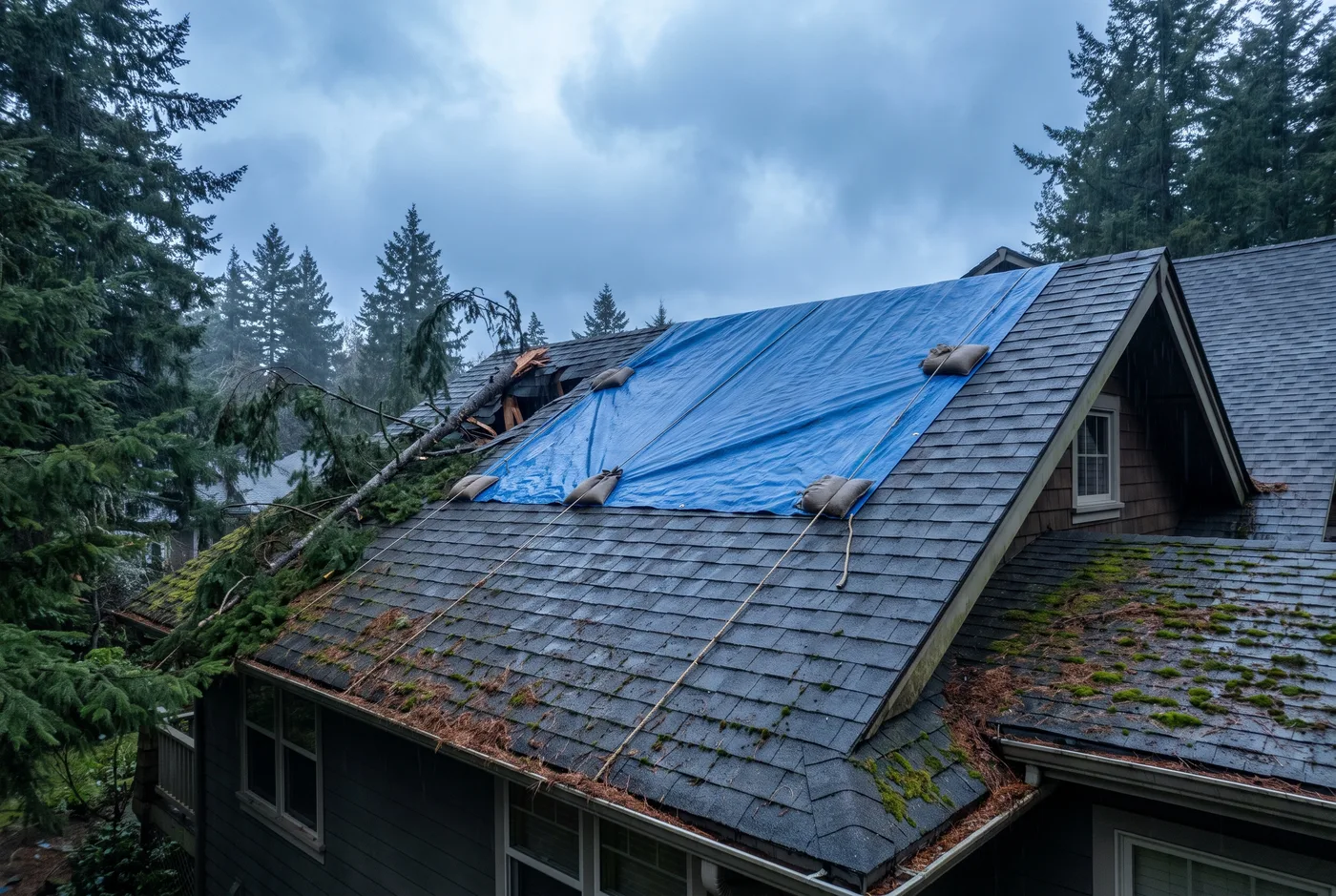
After storm damage, stop the water first. Get an emergency tarp over the hole, then take photos with dates before you touch repairs. Call your insurer to open a claim. Meet the adjuster with a licensed contractor’s written report, and only then okay permanent repairs. Acting fast protects your home and helps your claim.
What should you do right after roof storm damage?
The most important thing is to stop water from getting in. Damage inside your home builds fast, and insurers expect you to limit it. Work from the ground and stay off a wet, wind-loaded roof.
- Stop the water. Get an emergency tarp over the hole, or call us for storm & emergency roof repair and same-day tarping. Move furniture and valuables away from the leaks and set buckets under the drips.
- Take photos of everything. Shoot the roof from the ground, the debris in the yard, and every stain inside. Note the date, the storm, and the wind. Timestamps and wide shots matter.
- Call your insurer. Open the claim fast and write down your claim number and adjuster’s contact. Ask about your wind/hail deductible.
- Get two reports. Let the adjuster inspect. Have a licensed contractor give a written scope with photos, too. Our roof inspections and written estimates are free.
- Repair last. Okay permanent repairs only after the loss is on paper. Keep every receipt, including the one for the tarp.
Do not pressure-wash, clear debris off the roof, or start real repairs before you document it. You can wipe out the proof your claim needs.
Does insurance cover wind and storm roof damage?
Most Washington homeowner policies cover sudden storm and wind damage. What they leave out is slow wear: an old roof at the end of its life, moss rot on a shaded north slope, or leaks from skipped maintenance. The line between a “covered event” and a “maintenance issue” is where claims get denied. So honest records are everything.
| Usually covered | Usually NOT covered |
|---|---|
| Wind-lifted or blown-off shingles and shakes | Normal age and wear on an old roof |
| Torn or displaced flashing from a storm | Moss, algae, and rot on north slopes under fir |
| Tree limb or debris punctures | Damage from skipped maintenance |
| Sudden storm-driven leaks and interior water | Poor past workmanship or maker defects |
| Snow-load, ice-dam, or wind-driven rain getting in | Granule loss with no storm |
If your roof was already near the end of its life, an adjuster may pay only for a repair, not a full replacement. That is where our honest repair-vs-replace advice helps. Sometimes a targeted roof repair is the right call. Sometimes the storm is the last straw and it’s time to replace.
How does the Whatcom County insurance claims process work?
Every carrier is a little different, but the steps and rough timing look like this. Go in order and keep your paperwork tight.
| Step | What happens | Typical timing |
|---|---|---|
| 1. Document | Photos, dates, storm notes, interior damage | Same day |
| 2. Tarp / mitigate | Emergency tarping to stop further loss | Same day (local crew) |
| 3. File the claim | Call insurer, get claim number + adjuster | Within 24–72 hours |
| 4. Adjuster + contractor | On-site inspection; written scopes compared | 3–14 days |
| 5. Approval | Carrier issues scope and payment schedule | 1–3 weeks |
| 6. Permanent repair | Licensed crew completes the work | After approval |
A few dollar figures help set expectations. Emergency storm tarping usually runs $350–$4,000+, depending on roof size and access. Most tarps are paid back as loss prevention. A covered storm repair often lands in the $450–$3,500 range. A full storm-driven replacement runs $11,000–$40,000+. These are local estimates to teach, not a quote. A free roof inspection gives you your real number.
One detail catches many homeowners off guard: how the payout works. Many policies pay actual cash value (ACV) up front — the aged-down value of the roof. They release the rest, called recoverable depreciation, only after the work is done and billed. So your first check may look small, even on an approved claim. Know your deductible — wind/hail deductibles are often a percent of your dwelling coverage, not a flat amount. Check whether you have ACV or replacement-cost coverage. Keep every invoice so you can get back the held-back depreciation. We write our scope to match the carrier’s line items, which makes that last payment much easier to collect.
Why does a fast local roofer matter after a storm?
After a big blow, storm damage only gets worse the longer it sits open. A crew based two counties away has to load a truck, stage materials, and fight through a post-storm backlog before they even reach your street. We are a licensed, bonded, and insured Whatcom County contractor, already working across Bellingham, Ferndale, Lynden, and the foothills. So we can often tarp the same day. That speed limits water damage inside and helps your claim, because it shows you acted fast to prevent more loss.
Our local knowledge also shapes what we look for:
- Outflow winds funnel down the Nooksack and Fraser valleys through Sumas, Everson, and Lynden, and open farm and coastal country adds uplift — so we check ridges, hips, and rakes closely for lifted cedar shakes and shingle edges.
- About 35 inches of rain a year in Bellingham, far more in the foothills where winter also brings heavy snow load and ice dams, means a small lifted flashing turns into an inside leak fast.
- Salt air near the water — Bellingham Bay, Birch Bay, Blaine, Cherry Point — eats cheap fasteners. So storm repairs on coastal homes use rust-resistant hardware and, on metal, marine-grade Kynar 500 / PVDF coatings.
- Moss on shaded north slopes under Douglas fir can hide storm damage. So we split storm loss from old wear honestly in our report.
We serve Bellingham, Ferndale, Lynden, Blaine, Everson, and the Mount Baker foothills, plus outlying communities including Point Roberts, Sudden Valley, and Lummi Island.
How we work with your insurance adjuster
Claims go smoothest when the contractor’s scope and the adjuster’s estimate line up before work starts. Here is how we keep that easy:
- We meet the adjuster on site and walk the roof together, so nothing gets missed or argued later.
- We give a written, photo-backed scope with honest local pricing that includes haul-off and disposal — real costs, laid out clearly, with no surprise supplements.
- We document your loss prevention, including the emergency tarp, so it counts on your claim.
- We call repair-vs-replace honestly. If the storm only hit one slope, we say so. If your roof was already failing, we tell you that too.
- We back the work with a workmanship warranty once repairs are done.
You stay in control of your claim and your money. Our job is to make the roof right and give the adjuster clean, solid records.
Get storm damage handled fast
If the wind just took part of your roof, don’t wait — storm damage only spreads. Call Glacier Roofing at (360) 483-1333 for same-day emergency tarping and honest, local storm damage roof repair. Start with a free roof inspection and written estimate, or reach us through our contact page. We will help you stop the water, document the loss, and file a claim that holds up.
Frequently asked questions
Does insurance cover wind or storm roof damage?
What should I do right after storm damage?
How fast can you tarp a roof in Whatcom County?
Will filing a claim raise my premium or cost me out of pocket?
Do you work directly with my insurance adjuster?
Ready to move forward?
Talk to a local Whatcom roofer — free inspection, honest advice.