Published July 14, 2026 · by Glacier Roofing
Key takeaways
- Ice and water shield is a fully waterproof, peel-and-stick membrane. It seals a roof's weakest spots: valleys, eaves, and around penetrations.
- In the Mount Baker foothills it does exactly what its name says — stops ice-dam leaks under heavy snow. In the lowlands it blocks wind-driven rain from getting under your roofing.
- It works with synthetic underlayment across the rest of the roof, not in place of it.
- Ice-and-water membrane at valleys and eaves is usually required for a maker's full-system material warranty.
- Any good Whatcom re-roof should include it in the high-risk spots. Ask to see it listed on your written estimate.
When snow piles up in the foothills or rain blows sideways for days across the lowlands, plain underlayment isn’t always enough. That’s where ice and water shield earns its keep. It’s the one layer of a Whatcom County roof that is truly waterproof, not just water-resistant. Here’s what it is, where it goes, and why it matters out here.
Ice and water shield is a peel-and-stick, rubberized-asphalt waterproof membrane. It bonds right to the roof deck at valleys, eaves, and around penetrations like chimneys and skylights. Against Whatcom County’s foothill snow, ice dams, and wind-driven rain, it seals the roof’s most leak-prone spots, even when water is pushed uphill under the shingles or backs up behind an ice dam.
What exactly is ice and water shield?
Ice and water shield is a rubberized-asphalt membrane with a peel-off backing. Roofers roll it right onto the wood roof deck, where it bonds into one solid, fully waterproof layer. Its main trick is that it seals around fasteners. When a nail or screw goes through the sheet, the soft asphalt grips the shank so tightly that water can’t run down it into the deck. Plain felt and synthetic underlayment can’t do that. They shed water off the top but leave nail holes open. The membrane is also thicker and more bendable than felt. So it hugs corners, skylight curbs, and flashing without wrinkling. Because it’s truly waterproof, not just water-resistant, it’s saved for the parts of a roof where leaks really start, not spread across the whole deck.
Felt vs. synthetic vs. ice and water shield
Every re-roof needs some kind of underlayment between the roof deck and the shingles or panels. There are three common types, and a good Whatcom roof usually uses two of them together. Here’s how they compare on a local job:
| Underlayment | Relative cost | Waterproofing | Best use on Whatcom roofs |
|---|---|---|---|
| Felt (asphalt-saturated #15/#30) | Lowest | Water-resistant only; no self-seal; wrinkles when wet | Budget field layer on simple, low-exposure roofs |
| Synthetic underlayment | Mid | Highly water-resistant; lies flat, sheds rain, won’t tear in wind | Main field layer across the whole deck; standard on quality re-roofs |
| Ice & water shield (peel-and-stick) | Highest per square | Fully waterproof; self-seals around nails and screws | Valleys, eaves, penetrations, low-slope and snow/ice-dam zones |
Felt is the old standard. It’s cheap, but it wrinkles when it gets wet and only resists water. Synthetic underlayment is the modern layer: tougher, lighter, lies flat, and holds up far better through a wet Whatcom winter and a windy install day. Ice and water shield is the waterproofing specialist. You don’t wrap a whole roof in it. That wastes money and, on some roofs, can trap moisture. You put it right where water gathers or gets pushed uphill against the flow of the roof.
Where should ice and water shield be installed?
The membrane goes wherever water pools, funnels, or gets pushed backward. On a Whatcom County home, that means:
- Valleys. Where two roof planes meet, all that rain — and snowmelt in the foothills — funnels into a fast-moving channel. Valleys are the most common leak point. So a full-width run of ice and water shield goes down first, before any flashing.
- Eaves. The lower edge of each roof plane is where wind-driven rain pushes water back up under the first courses — and, in the foothills, where ice dams form and force meltwater backward. Membrane here protects the deck and the top of the wall below.
- Around penetrations. Chimneys, skylights, plumbing vents, and dormers are holes in the roof, and every hole is a leak waiting to happen. The membrane wraps these before the metal flashing goes on.
- Rake edges and low-slope sections. On wind-exposed roofs, and on any pitch shallow enough that water drains slowly, the extra waterproofing pays off.
- Sidewalls and dead valleys. Anywhere a roof meets a wall, or a spot where water can hang up instead of running clear.
On steep, well-drained areas, synthetic underlayment does the job just fine. The membrane’s cost and labor go only where they matter. That keeps the roof watertight and fairly priced.
What happens if a roof is built without it?
Corners get cut, especially on quick or cheap re-roofs. When ice and water shield is left out of the valleys and eaves, the roof can look perfect for a year or two. Then a hard November storm drives rain uphill, or a foothill cold snap sets an ice dam at the eave. Water finds a nail hole or an open valley seam and runs down into the deck and ceiling. Most leaks our roof repair crews trace start in exactly these spots: a valley or a skylight curb that never got proper waterproofing under the visible roofing. Fixing it later usually means tearing back finished roofing to reach the bare deck. So it costs far more than doing it right the first time.
Do you need ice and water shield in the Pacific Northwest?
Yes — and in Whatcom County the name fits better than you’d think. Up in the Mount Baker foothills — Deming, Maple Falls, Glacier, Kendall — heavy snow load and ice dams are a genuine winter threat. When snow melts against a warm roof and refreezes at the cold eave, it dams up and forces water backward under the roofing. Ice and water shield is exactly what stops that. Down in the lowlands, hard freezes are less common and the threat is water: about 35 inches of rain a year in Bellingham, heaviest in November, often driven nearly sideways by cold Fraser/Nooksack outflow wind. That wind-driven rain gets pushed uphill under shingles and into valleys — just what a waterproof membrane is built to stop. Add the steady damp that feeds moss on shaded north slopes under the Douglas firs, and the case for sealing your roof’s weak points is strong across the whole county. It’s a small line item against the full cost of a new roof in Whatcom County. And it’s one of the first things we spec, whether you’re leaning toward metal or asphalt shingles.
How ice and water shield fits a proper re-roof system
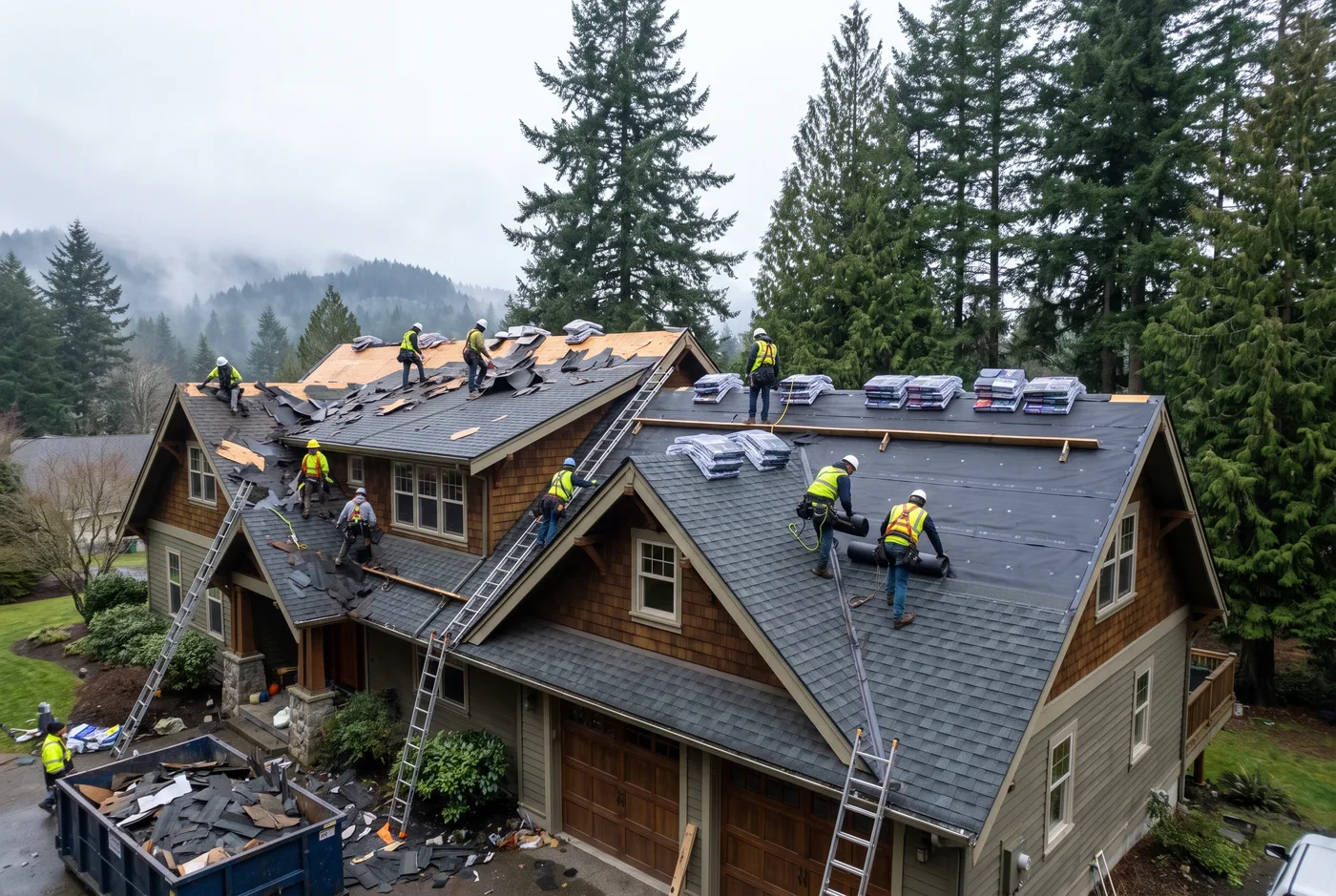
Underlayment isn’t a stand-alone product. It’s part of a layered system, and the layers have to go on together to work and to be covered by warranty. On a quality roof replacement, the order from the deck up looks roughly like this:
- Ice and water shield at valleys, eaves, and penetrations.
- Synthetic underlayment across the rest of the deck, lapped over the membrane.
- Flashing at every edge, valley, and penetration.
- Shingles or standing-seam panels as the finished surface.
- Ridge venting and, where moss is a concern, zinc or copper strips near the ridge.
Makers of both shingles and standing-seam metal roofing tie their strongest material warranties to a full-system install. That almost always includes ice-and-water membrane in the high-risk areas. Leave it out, and you can void the coverage you paid for. Do it right, and the waterproofing layer stays hidden for the life of the roof — which is the point. That’s why we list underlayment on our written estimates. We’re a licensed, bonded, and insured WA roofing contractor, and we back every re-roof with a workmanship warranty. We’re glad to show you exactly where the membrane goes on your roof before we start.
Get a straight answer on your roof
Not sure if your roof has proper waterproofing in the valleys and eaves? Or if a nagging leak traces back to missing membrane? A free on-site inspection will tell you, with honest repair-vs-replace advice and no pressure. Contact us or call (360) 483-1333 for a free inspection and written estimate anywhere in Whatcom County — Bellingham, Ferndale, Lynden, Blaine, Everson, and the Mount Baker foothills.
Frequently asked questions
Do I need ice and water shield in the Pacific Northwest?
Where should ice and water shield be installed?
What's the difference between felt, synthetic underlayment, and ice and water shield?
Does ice and water shield go under a metal roof?
How much does ice and water shield add to a roof cost?
Ready to move forward?
Talk to a local Whatcom roofer — free inspection, honest advice.